3D Cuboid Annotation

Professional 3D annotation for depth perception

Expert 3D cuboid labeling for autonomous vehicles, robotics, and AR/VR applications. Capture spatial dimensions and object orientation with precise depth information for next-generation computer vision models.
TRUSTED BY
Waymo
Tesla
Cruise
Aurora
Zoox
Mobileye

Annotation Capabilities

Comprehensive 3D cuboid annotation

Advanced spatial annotation for autonomous systems requiring precise depth and orientation data

Autonomous Vehicles

3D object detection for self-driving cars with precise spatial awareness and distance estimation.

Robotics & Manipulation

Enable robots to understand 3D space for accurate object grasping and navigation.

AR/VR Applications

Spatial understanding for immersive augmented and virtual reality experiences.

Warehouse Automation

3D package detection for automated sorting, stacking, and inventory management systems.

LiDAR & Point Cloud

Annotate 3D point cloud data from LiDAR sensors for precise environmental mapping.

Dimensional Analysis

Extract precise width, height, and depth measurements for quality control and inspection.

Our Process

How 3D cuboid annotation works

A precise workflow that captures full 3D spatial information with depth-aware annotation

STEP 1

Upload 3D Data

Upload images with depth information, LiDAR scans, or stereo camera footage

STEP 2

Define Objects

Specify object classes and 3D annotation requirements for your use case

STEP 3

3D Box Placement

Experts place 3D cuboids with precise dimensions and orientation angles

STEP 4

Depth Verification

QA team validates 3D coordinates, dimensions, and spatial accuracy

3D annotation at scale

Powering autonomous systems and spatial computing worldwide

20M+

3D objects annotated

99.7%

Spatial accuracy

48hrs

Average turnaround

6DoF

Full pose estimation

Use Cases

3D cuboid annotation across industries

Enabling spatial intelligence for cutting-edge applications

Autonomous Vehicles

3D object detection & tracking

Robotics

Object manipulation & grasping

AR/VR

Spatial scene understanding

Warehouse

Automated sorting & logistics

LiDAR Mapping

Point cloud annotation

Delivery Drones

Obstacle avoidance

Retail

Product dimension analysis

Smart Home

3D space mapping

Ready to enable 3D perception?

Get professional 3D cuboid annotations for your autonomous systems, robotics, and spatial computing projects.

3D Cuboid Annotation FAQs

Common questions about our 3D annotation services

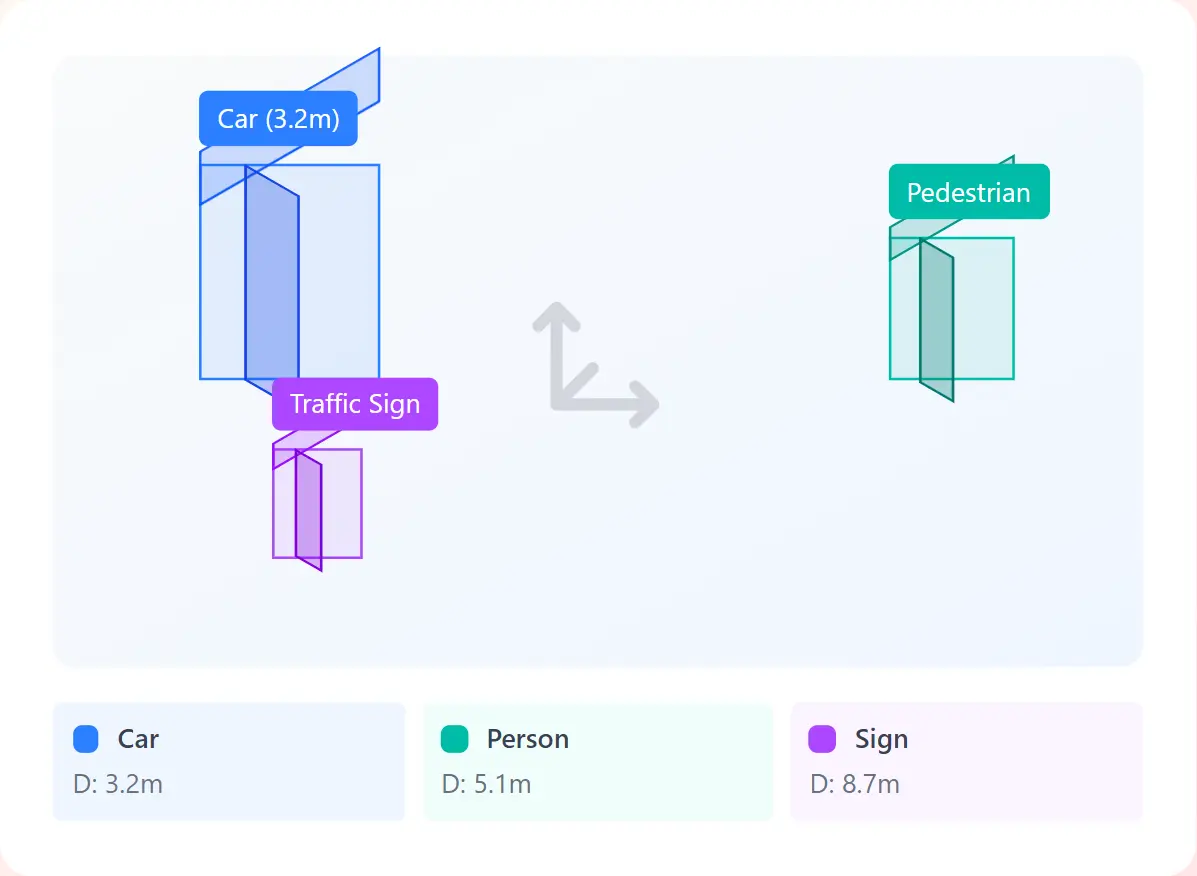
3D cuboid annotation involves placing three-dimensional bounding boxes around objects in images or point clouds. Each cuboid includes 8 corner coordinates defining its position, dimensions (width, height, depth), and orientation in 3D space. This enables depth perception and spatial understanding critical for autonomous vehicles, robotics, and AR/VR applications.

We support multiple 3D data formats including stereo camera images, RGB-D (depth) images, LiDAR point clouds (PCD, LAS, PLY), multi-view camera setups, and sensor fusion data. We can work with KITTI, nuScenes, Waymo Open Dataset formats, and custom data structures.

Our annotators use specialized 3D annotation tools that leverage depth information from sensors like LiDAR or stereo cameras. We verify cuboid placement across multiple views, validate dimensions against sensor data, and employ a multi-layer QA process. Our accuracy rate for 3D spatial coordinates is 99.7%.

Yes, our expert annotators are trained to handle partial occlusions. We use context from visible portions, multi-frame temporal information for video sequences, and depth data to estimate the full 3D extent of partially visible objects. This is especially important for autonomous vehicle scenarios with complex urban environments.

We provide 3D annotations in industry-standard formats including KITTI format (for autonomous vehicles), nuScenes JSON, Waymo TFRecord, custom JSON with 3D coordinates and rotation quaternions, and framework-specific formats for PyTorch3D, Open3D, and PCL (Point Cloud Library).

3D cuboid annotation is typically 2-3x more expensive than 2D bounding boxes due to the increased complexity of spatial reasoning, depth estimation, and orientation determination. However, the rich 3D information enables more sophisticated AI models with better real-world performance, making it essential for autonomous systems and robotics applications.