

When it comes to supervised machine learning models, data labeling is one of the most important steps. Yet, many business owners struggle to understand how this process works.
Given the significance of labeled data for training ML models, understanding labeling and its working is very important. That’s exactly why I’ve written this guide: so that you don’t have to dig into the technical details and topics.
You’ll get to know why this market is expected to grow beyond $7 billion by 2031 and how outsourcing data labeling services can help your business.
So, What is Data Labeling?
First, let’s understand what this term represents: “Data labeling is the process of assigning labels to training data so that machine learning models can make accurate predictions.“
Think about this example: how does a machine learning model learn to differentiate between dogs and cats…or between humans and cars?
It all depends on the labels assigned to each element in the training dataset. This is the key to supervised ML algorithms learning to identify patterns and behavior. Simply put, a more efficient data labeling process leads to more accurate outputs from AI models.
Why is Data Labeling Important for Machine Learning?
Now, you have a basic understanding of the data labeling process.
To get an idea of why data labeling is so crucial for any ML model, let’s discuss the key benefits of this approach:
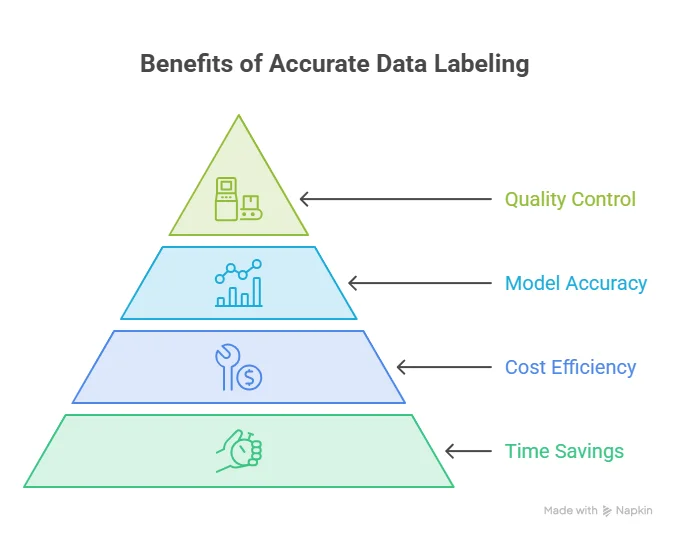
1. Saves You Time
High-quality data labeling helps machine learning models learn from accurate data. As a result, your development spend less time correcting errors and retraining models. They can focus primarily on building the models.
In short, accurate data labeling can speed up the development process, and AI-based applications are delivered faster.
2. Ensures Cost Efficiency
Your business can also reduce operational costs with automated labeling tools for repetitive tasks (while still relying on human annotators for quality assurance).
This approach reduces estimated project costs (as you will need fewer human annotators to complete the annotation tasks). A smaller number of resources needed to complete a project means more cost savings for your business.
3. Improves Machine Learning Model Accuracy
Most machine learning models rely primarily on the quality of their training data; supervised machine learning models learn patterns based on the labeled data they are fed.
And this means that high-quality labeled datasets can help you build AI systems that are well-equipped to recognize patterns and make accurate predictions (when exposed to new data).
4. Offers Better Quality Control
When your annotation teams follow pre-defined labeling guidelines and standards, they can maintain consistency and accuracy across all raw datasets. This means that as a business owner, you can ensure high-quality datasets with minimum labeling errors.
What are Different Types of Data Labeling?
If you have been wondering what is data labeling, now you know it’s the process of assigning meaningful labels to raw data for AI training.
Now, let’s look at the different types of data labeling and how each one supports specific machine learning applications.
1. Image Labeling
Image labeling is the process of assigning labels to objects or regions within an image so that machine learning models can recognize visual patterns.
It is widely used in applications such as self-driving cars, facial recognition, medical imaging, automated checkout systems, and other computer vision systems.
2. Text Labeling
Text labeling is a data labeling approach that involves assigning labels to text data in a training dataset.
The goal is to help machine learning models understand:
- Meaning of the text data
- Context of the text data
- Intent of the text data
3. Audio Labeling
This is a type of data labeling approach that involves assigning tags/labels to sound segments in the training dataset. This is crucial for the ML models to identify and respond to user voice input.
Keep in mind that audio labeling is fundamental to AI voice recognition software and smart assistants, such as Alexa, Apple Siri, and Microsoft Copilot Voice. The next time you interact with a virtual assistant, remember that its ability to understand and interpret your voice is made possible by accurately labeled audio data used during model training.
4. Video Labeling
In this process, annotators assign labels to objects and actions across multiple video frames. The goal is to convert raw video data into a structured, labeled dataset for machine learning models.
Whenever you hear the term video labeling, think of AI-powered applications such as CCTV monitoring, smart cameras, and surveillance systems that depend on accurately labeled video data.
In-House vs Outsourced Data Labeling: Which Approach is Ideal for You?
In simple words, there’s no clear-cut answer to this question. Whether you choose to build an in-house team or outsource your data labeling project depends on your business goals, requirements, and budget.
The following table will provide you with a clear picture:
| Factor | In-House Data Labeling | Outsourced Data Labeling |
| Cost | High upfront costs | Cheaper and budget-friendly option |
| Time to Deployment | Slower because of recruitment and training | Faster labeling + rapid model training |
| Quality Control | You have direct oversight of the whole process | Quality ensured via SLAs and set procedures |
| Best For | Long-term projects with consistent data volumes | Short-term and rapidly scaling projects |
5 Common Use Cases of Data Labeling
Now, I will explain how the data labeling process plays a part in our everyday lives:
1. Autonomous Vehicles
How do self-driving cars identify objects and differentiate between pedestrians, vehicles, and traffic lights?
This is achieved by training AI models on thousands of accurately labeled images and videos. As data scientists train machine learning models using this labeled data, the models learn to recognize patterns in unseen driving scenarios.
This is how AI-powered autonomous vehicles are able to learn patterns and make correct decisions (i.e., avoiding obstacles, identifying pedestrians, and making turns based on road conditions).
2. Facial Recognition Software
Facial recognition software relies on data labeling to accurately identify and distinguish between individuals.
High-quality annotations help AI models recognize unique facial features by training them on thousands of labeled facial images.
This makes facial recognition technology suitable for applications such as:
- Smartphone unlocking
- Airport security
- Employee attendance systems
- Access control
- Home security systems
3. AI Customer Support Chatbots
Nowadays, many businesses use AI-based customer support chatbots to handle customer queries. These chatbots rely on labeled text data during training.
By learning from a labeled dataset (containing past user interactions), machine learning models can provide more accurate and personalized responses. This way, businesses respond to customers faster and improve the overall support experience.
4. Content Moderation
Millions of images, videos, and text posts are uploaded to online platforms every day. And reviewing this content manually is both time-consuming and virtually impossible.
This is another area where data labeling can help you. Once models are trained to identify explicit comments, hate speech, and unwanted content, AI tools can make the task of moderating content much easier for you.
5. Social Media Marketing
Data labeling can also play an important role in promoting your brand on social media much more effectively.
But how is this possible? You can employ AI-powered analytics tools; these systems are trained on labeled social media data (such as user comments, reactions, and hashtags).
This way, machine learning models can identify the interests of your target audience by learning from labeled information.
This allows you to:
- Create content more relevant to your audience
- Enhance the visibility of your brand by identifying the most relevant trends
Why Choose Annotation for Data Labeling
Training an AI model accurately is not that easy. And if you’re struggling with the data labeling process, you are not alone. But here’s the good news: you can outsource your data labeling services to Annotation.
At Annotation, our team specializes in accurate data annotation services. With reliable data labeling services, we help you reduce costs, save time, and build more accurate AI models.
The best part? You can outsource your labeling tasks from just $5 per annotation hour. Get in touch with us today, and let us know how our annotation team can help you.